Showing posts with label Oracle. Show all posts

Friday, January 11, 2013

Batgirl #3 (June 2000)

Batgirl #3 (June 2000)
Script: Scott Peterson, Kelley Puckett
Pencils: Damion Scott
Inks: Robert Campanella
Colors:  Jason Wright

Synopsis:  Batman takes Batgirl along to rescue a kidnapped child and his protege fights her first "metahuman" opponent, a brute with facial piercings.  Battered and exhausted, Batman heads back to his lair only to find himself shaken to his very core after he watches a snuff film starring a very familiar little girl.

This is one of those issues where Batman comes close to being an intolerable jerk.  I'm wrong.  Not close so much as dead smack in the center of it.  Let's face it-- the Batman not only touches being a jerk, he smashes his head into jerkdom repeatedly, cracking it and spoiling its value for other arch-jerks like Guy Gardner.  Fortunately, Oracle calls him on it.  Batman shows up babbling nonsense about Batgirl having failed the poor guy from the previous issue, the guy she did everything humanly possible to save and Oracle sensibly tells the Caped Crusader if he tells Cass any of that he's no longer welcome to hang out and play Marvel vs. Capcom 2 with her anymore.  There's a difference between being the consummate bad-ass, driven by your obsession and being both a moron and a prick who demands your apprentices become somehow omniscient and omnipresent.  Batman seems not to realize this.

The plot is framed by a bleeding and emotionally devastated Batman remembering the events that unfold in this story and then the moment where he took the hit that laid him so low-- that little video showing a pony-tailed child at play, a game that involves tearing out a full-grown man's throat.  Then doing other stuff to him that's apparently so horrifying we're not even allowed to see it on-panel, just Batman's open-mouthed reaction along with some sound effects.

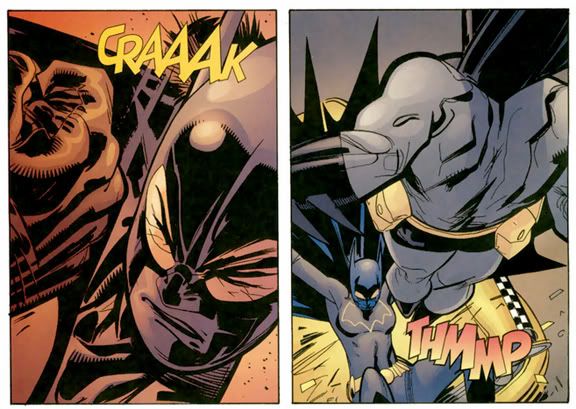
Once again Peterson and Puckett script a quick-paced story with a bare-bones plot but maximum impact.  The fight with the metahuman-- the Comixology blurb names him as Meta (which is perhaps the lamest on-the-nose codename since Hiroko Ichiki took the name Armor during the Joss Whedon run on Astonishing X-Men) but I don't think he's called anything in the story itself-- is appropriately frenetic with a neat physical contrast between the combatants as lithe, small Cass clambers all over this man-mountain in an attempt to stop him.  It's an apparent mis-match, but shows Cass as determined, almost suicidally so.  This will become more apparent over the next few issues.  The fight could be more brutal and frightening.  A little more alarm from Batman would have set up further character developments, but it's an easy sequence to scan.  Scott excels at showing bodies in motion and Campanella's inks keep things clean and readable.

I'm guessing in the DC universe being "meta" is similar to being a mutant in the Marvel universe-- just a catch-all term for what amounts to magical abilities.  The guy Cass fights isn't explained and his abilities seem to consist of unusual size, strength and constitution.  On planet Marvel, being a mutant means you can have pink hair and pixie wings if that's what the kids are into that year, or you can have a plastic cash register for a head and "Money" as your code-name if the writer is some kind of whimsical dimwit.  Calling it a mutation just gives it a pseudo-scientific gloss.  Similarly, in Gotham City, if you're meta, you're just pierced and tough if that's what the story calls for this month.

Despite taking up the most story pages, the fight isn't even the most interesting thing that happens in this issue.  We get more Cass backstory as she flashes back to a fun day she had with daddy Cain (assembling an automatic pistol while he playfully covers her eyes, her expression one of pure joy at completing it in record time; that it isn't more horrifying is more the result of the slick, cartoony art working against the mood rather than supporting it than the idea of this man essentially warping a child's mind and betraying her innocence and trust in the father-daughter dynamic) and then the Bat-poop starts to hit the Bat-fan thanks to the video.  Here the main thrust of Cass's narrative really begins, where she will battle with her own guilt and resulting death wish and Batman's unrealistic expectations and whether or not he feels she's worthy as a successor to his Bat-franchise.

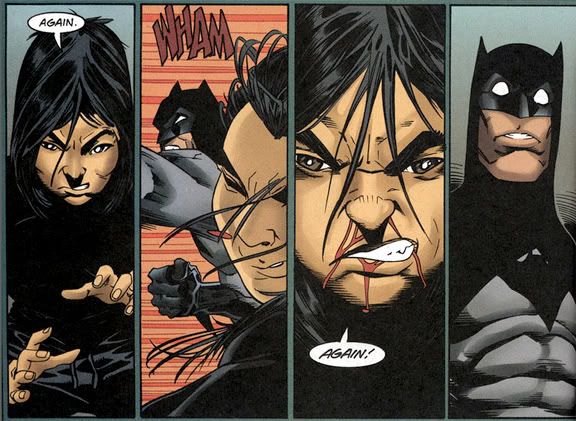
Cass's continued terse-ness is fun, too.  She's developing a small vocabulary of simple words she deploys like weapons.  Batman lectures her on expecting the impossible before he realizes she doesn't understand anything he's saying.  He asks her if she does and she simply replies, "No."  You get the feeling she probably picked up on more of his meaning than she lets on and rejected it as just as stupid as Oracle did.  She does use at least Batman's body language as inspiration during her big fight scene.  Batman's right about one thing-- if you are actually present and wearing the costume, you can't allow yourself to fail (but all that noise about not allowing yourself to fail when you're not present is, again, idiotic, like something Joseph Heller would come up and have some satirical fun with).

The art team does even more to help her communicative skills by drawing her (and every character, for that matter) with scene-specific facial expressions.  They stick with the broader strokes, though.  Peterson seems to love the low-angle distorted face, as if seen through a fish-eye lens, all chin and gigantic noses with startled eyes and gaping mouths.  He can't seem to decide on a musculature for Cass at times, but this is probably a product of his energetic pencil stylings.  His art is much more expressive than realistic and occupies a continuity with Bruce Timm and early-career Bernie Wrightson, but without their ability to work darker moods.  What he and Campanella have together is oodles of appeal.  The panels ripple with movement and energy and they're just pleasing to look at.  Still, Cass has massively muscular thighs in her first appearance, then turns wiry and thin-limbed for the rest of the book.  Yet little Cass looks pretty much like teen Cass, just smaller.  I have to wonder when those ponytails sprouted, since she seems to have worn the same hairstyle as a child she does as Batgirl.

Once again, a vivid story that takes all of about five minutes to read but providing just enough depth to keep you curious, to make you want more.  Slowing down a little and focusing more on the subtle emotions instead of the broader strokes might have elevated this issue to a true classic.  I remember reading this a year or two after it came out and feeling they were in danger of using up all the A-material.  But the potential for Cass as a character seems limitless and we're only three months into the series.

Monday, January 7, 2013

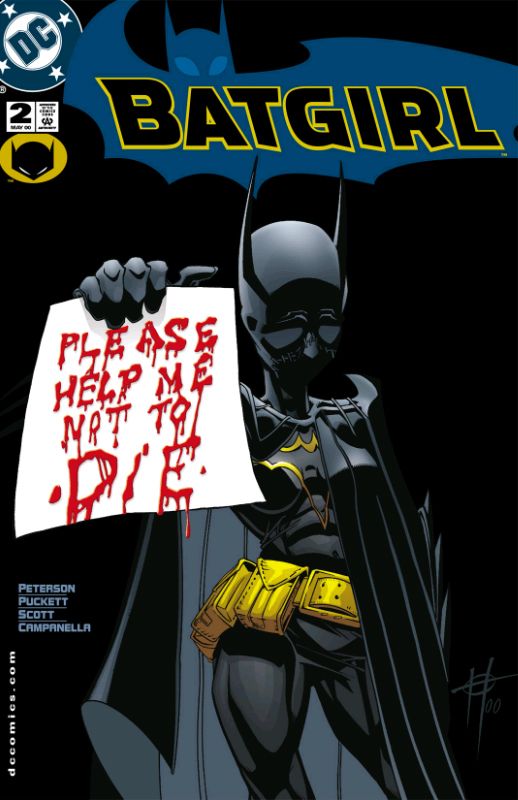
Batgirl #2 (May 2000)

Batgirl #2 (May 2000)
Script: Scott Peterson, Kelley Puckett
Pencils: Damion Scott
Inks: Robert Campanella
Colors:  Jason Wright

Synopsis:  After playing the good samaritan and intervening in some kind of mob-related romantic altercation, Gotham citizen John Robinson needs a helping hand himself.  Of course it's Batgirl who leaps into action.  When she finds out Robinson's been kidnapped by the mobsters, her protective nature kicks into overdrive. Oracle helps her locate the guy, but if only Cass had better verbal and written communication skills-- or any at all-- she might have avoided a harsh lesson in love and loss.

This is a taut stand-alone tale of the kind I wish comic book publishers did more of these days.  With nary a wasted moment-- and despite an emphasis on action and fights-- Scott Peterson and Kelley Puckett introduce a minor character, develop him just enough so you have real concern for his plight, rather than just have him exist as a inciting element.  Certainly, he's that, but a little more than that, too.

The writers also use a point of view change near the end to enable readers to see Cass from the outside, but as the melancholy ending shows, they don't neglect her inner being either.  Actually, this is the first issue where we see signs of some of her signal personality traits-- there's the impulsivity which gets her involved with the good samaritan in the first place (and leads her to plant a quick kiss on his cheek as a reward for his being such a nice guy) and the irresistible way she draws support from Oracle without using words.  This issue introduces Cass's implacable, on-task nature.  Once she sets off to rescue the kidnapped man it's all Oracle can do to keep up with this whirlwind in black.  Oh yeah, and there are a number of violent action sequences, starting with the initial fight that sets up the plot and ending with Cass taking on a whole bunch of suited Mafia types all by her lonesome.  It's not on the level of the Bride versus the Crazy 88s, but I have a feeling if it had been Cass in the House of Blue Leaves, there would have been no fatalities but the fight would have lasted only half as long.

Cass begins to show signs of understanding at least a minimum of English.  Her ability to read body language means she's not completely incommunicado, but while she seems unconcerned and even mocking about learning at the outset-- much to Oracle's understandable frustration-- she comes to realize by story's end not only is she cutting herself off from human interactions, she's hurting herself as far as the Batgirl identity goes.  Knowing more than a word or two may come in handy when fighting crime.

This story reminds me of one of Will Eisner's The Spirit, which sometimes featured a simple plot rounded out with humanism or a particular mood somewhat deeper than your usual pulp actioner.  "The Story of Gerhard Shnobble," about a schmoe who could fly, for example.  It's a bit of downbeat fantasy, more a vignette than full-fledged narrative, with the Spirit relegated almost to the background.  Eisner shows the Spirit's adventures sometimes have unintended consequences and they're not the only thing happening in this particular world.  John Robinson is Cass's Shnobble, the major difference being she actually interacts with him and has an emotional epiphany as a result, which is the purview of the readers and denied the Spirit in Eisner's tale.  But in the same way Shnobble deepens the Spirit's world, Robinson reminds us Gotham City as a story setting is packed with people living fully dimensional lives and the impact they might have on Batgirl and vice versa.  It's Eisnerian to see Cass through Robinson's eyes and provides the feeling of what it must be like to live in a city lousy with black-costumed heroes and their vicious enemies.  Simply by trying to do the right thing, this ordinary man is caught between the two extremes and pays a heavy price, but it's the emotional impact on Cass and on Robinson's wife we're concerned with rather than just the mechanics of a typical Cass ass-kicking.

The final panel is particularly reminiscent of Eisnerian storytelling as well.  Because Eisner was a genius, it's not as heartbreaking as anything in "Gerhard Shnobble" (which ends with a note it's humanity we should pity, not Shnobble), but it's affecting.  There's a potential here for some truly ground-breaking storytelling, with Batgirl experiencing the superheroic world as an outsider, almost an alien observer of these human mysteries, her interactions sometimes confusing and as painful for her as it is for the people she beats up so thoroughly.  With its whip-snap narrative speed, the series doesn't do a whole lot with this theme from here on out, but it's evidence of the basic richness of Cass the character there are so many different directions a smart writer could take her, from traditional adventure to stories with more emotional resonance, or-- my preferred route-- doing both a la Koike Kazuo's Lady Snowblood and Lone Wolf and Cub.

I have to admit the first time reading these I found Damion Scott's layouts and panel-to-panel flow difficult to follow.  Now I think I have a handle on them.  There are a lot of nice moment-to-moment-- or what Scott McCloud would call action-to-action-- progressions here.  Robinson picks up a board (which, frankly, Scott renders haphazardly), wades into the fight.  Towards the end, Batgirl becomes a veritable whirling dervish of destructive energy.  Scott doesn't neglect the acting-- the facial expressions and body language here are broad and cartoonish but far superior to some of the crap I've seen names with larger fanbases pull off.  And it beats the stiff "I use Poser models to plan my pages" or overly photo-referenced stuff some of the realists do.  Sequential storytelling is a complex art unto itself and Scott nails it here.

Wednesday, December 19, 2012

Cassandra Cain Versus the Deadly Viper Assassination Squad Vol. 2

We pick up our story in Tokyo, where Cass has beaten O-Ren Ishii and her bodyguards, the Crazy 88.  An angry Batman flies in to scold her and drag her reluctantly back to Gotham City.  Undaunted, Cass flees and after a brief night-time chase, eludes her mentor.  She knows she's risking a complete break with the man who has rapidly become a second father to her, but she's driven by her need to pursue these unusual and deadly people who remind her so much of herself.  Inside Cass rages a crisis of identity.  Using her own resources, she slips back across the Pacific and into the U.S. only to meet...

California Mountain Snake (Elle Driver).  California Mountain Snake briefly lulls Cass into a false sense of security by posing as an ally, but when the moment is right, strikes.  What follows is another sword fight, but Cass has developed katana expertise beyond anything California Mountain Snake can handle.  Cass ends the fight by temporarily blinding the one-eyed killer with a bright light, slipping behind her and shoving her into a filthy dumpster.  She closes the top and uses a small metal torch from her utility belt to seal it shut.  As Cass slips away, we hear California Mountain Snake raging and pounding away helplessly inside her dark prison.

Black Mamba/The Bride (Beatrix Kiddo).  Following up on information gleaned from Cass's defeated foes, Oracle reveals to Batman the location of the comatose Black Mamba.  Batman heads there hoping to intercept Cass who must also have access to this information.  Sensing something sinister at the facility, and backtracking the patient's origins, Batman begins to piece together the puzzle of the Deadly Viper Assassination Squad.  When Cass finally does show up, Batman realizes he must let her work through her issues.  Grimly, he gives her approval to confront Bill himself.  If she can find him.  Because of the strain it's caused in their relationship, it's the most he's willing to do.  Oracle chides him for testing the girl and Batman questions his own motives.

But not before Black Mamba recovers from her coma during a course of events that exactly follow those in Kill Bill Vol. 1.  A freed California Mountain Snake makes her aborted attempt on Black Mamba's life.  Black Mamba kills her tormentors and regains the ability to walk and fight.  Cass confronts her before she heads off to wreak vengeance on the Deadly Vipers and Bill.  Realizing Cass is after Bill as well, Black Mamba cannot allow her to defeat him before she takes her own shot.  The two fight, a long, running battle that takes place over the rooftops near the hospital a la Crouching Tiger, Hidden Dragon, with Black Mamba pursuing Cass just as Shu Lien did Jen Yu.  Both combatants believe the other knows where Bill is hiding.  They're fairly evenly matched, with Cass holding a slight advantage.  When the truth that neither knows where Bill is comes out, they stop their match and Black Mamba exacts an honor vow from Cass that they will meet again when it is all over and settle their differences once and for all, but that she must be the one who kills Bill.  Cass is shocked because she had only thought of bringing Bill to justice for his crimes and once again, she sees a reflection of the self she could have been.  In her confused state, she allows Black Mamba to slip away and experience the events of the Quentin Tarantino film.  Deciding she has to redeem herself in Batman's eyes, Cass breaks the vow she's only just made and grimly follows Black Mamba from a distance.

Bill.  Pursuing Black Mamba, Cass returns to many of the locations from the previous volume, only too late.  She witnesses the carnage left in Black Mamba's wake, becoming increasingly distraught at what she feels resulted from her failure to stop her when she had the chance.  She fears Batman will never forgive her for her lapse.  It's a horrible nightmare trip for her, a dark journey through an underworld she might once have easily inhabited herself.

After encountering the maimed Sofie Fatale and learning Bill's whereabouts, and having a phone conversation with him-- one-sided, of course, because Cass can barely understand what he's saying-- where Bill attempts to work his own charms on her and bring her onto the Deadly Viper Assassination Squad as its newest recruit (using the same logic he employs on Beatrix Kiddo in the film), Cass has an epiphany and now knows she has to save Bill from Black Mamba even though she considers him a very bad person indeed.

Unfortunately, she's once again too late and can only helplessly watch Bill's final moments.  Although she can't fully comprehend the feelings that pass between Black Mamba and Bill, she does know there are some things beyond her limited emotional experience.  Now having learned the full story and what the Deadly Vipers did to Black Mamba when she was The Bride, Cass offers a truce.  Seeing the now at peace Beatrix Kiddo reunited with her daughter sends Cass winging back to Gotham City to repair her relationship with Batman.  And to begin her own search for her elusive mother.  Of course the rigid Batman isn't too happy with her performance, but Oracle convinces him to back off for now.  There are some things about Cass that are also mysteries to them.

Yeah, kind of anti-climactic, huh?  Oh well, they can't all be winners.

Tuesday, December 18, 2012

Cassandra Cain versus the Deadly Viper Assassination Squad Vol. 1

It had to happen.  After briefly considering a fight between Cass and Mr. Kotter and his Sweathogs, I found myself thinking back to all those times-- possibly hundreds-- when I've suggested Cass's Batgirl series should have been more violent and tragic, along the lines of a Kazuo Koike work.  Lady Snowblood, for example, which provided Quentin Tarantino with some of his Kill Bill inspiration.  From there it was a simple imaginative leap to what I modestly call the Fight of the Century.

Cassandra Cain versus Bill and his Deadly Viper Assassination Squad.

Forget Vinnie Barbarino and Freddie "Boom Boom" Washington (for now).  Let's follow Cass around the world as she battles the most proficient team of professional killers ever known, each with his or her own murderous specialty.  Except for Bill himself and Beatrix Kiddo, who appear to be polymaths of death.

To be quite honest, there is no way an assassination squad operating on the highest levels like the Deady Vipers would ever confront Cass mano-a-mano.  Realistically, Bill would just have O-Ren "Cottonmouth" Ishii snipe Cass from a distance, fight over.  But even to accept the existence of people like these-- Cass aside-- requires suspension of disbelief.  And once having done that, we demand they put their skills on full display for our amusement.  And anyway, the possibilities contained within this scenario give me chills.  And they're multiplying.  I'm losing control.  Because the power this fight is supplying is electrifying!

Copperhead (Vernita Green).  Bill sends Copperhead, expert in both hand-to-hand combat and knife-fighting, after Cass first.  Copperhead wisely chooses to ambush Cass and their fight is a vicious one.  Copperhead is good, damn good, but she finds herself unable to land anything more than ineffectual glancing blows, and Cass manages several wicked strikes to let Copperhead know she's open for business.  At this point, Copperhead escalates the conflict with throwing knives, which Cass dodges.  As Copperhead tires and grows more desperate, she begins to make mistakes and Cass soon takes advantage, slipping inside Copperhead's guard, disarming her (breaking her wrist in the process), then putting her to sleep with a choke hold.  To Cass's surprise, Batman points out Copperhead actually managed to slice her just once, a shallow wound easily bandaged and not likely to cause any loss of speed or mobility.  Ashamed, Cass silently vows to do better next time.  Next time comes quickly...

Sidewinder (Budd).  Bill's brother Sidewinder is a more pragmatic fighter and comes after Cass with a shotgun loaded not with rock salt but with 12 gauge 00 buckshot.  Unfortunately for him, Copperhead's failure has cost the Deadly Vipers the vital element of surprise and Cass combat-rolls underneath the blast and comes up fighting.  Sidewinder is forced to use his shotgun as a club, but Cass has her opponent off-balance, landing a flurry of blows the tough Sidewinder almost manages to shrug off.  Years of alcohol abuse have dulled his combat edge, though, and Sidewinder succumbs faster than Copperhead.  A hotel room key leads Cass and Spoiler to Sidewinder's temporary lodgings, a seedy motel in a run-down Gotham City suburb.  There, among Sidwinder's possessions, Cass finds a katana.  Batman traces it to Hattori Hanzo and even though he forbids Cass to pursue the matter further and instructs her to shelter in a secret hideaway while he himself deals with Bill's assassins, Cass disobeys, but not before incapacitating Spoiler to keep her friend out of danger.  It's off to Okinawa for Cass.  Despite her lack of language skills, she's able to engage Hanzo in a quick "conversation" at his sushi restaurant and learns the next Deadly Viper to try her hand will be none other than...

Cottonmouth (O-Ren Ishii).  Just as the Bride's fight against Cottonmouth provided a violent spectacle at the end of the first Kill Bill, so must Cass's because it involves scores of black-suited gangsters doing their best to be the immoveable object in front of her unstoppable force.  O-Ren Ishii holds court at the the House of Blue Leaves, a large izakaya where she's protected by the Crazy 88 and serenaded by The 5678s.  Cottonmouth has learned the fates of both Copperhead and Sidewinder via Sophie Fatale's line of communications to Bill, and believes herself ready.  Cass infiltrates the izakaya and lays waste to the Crazy 88 in a spectacular fight scene that puts the one in Kill Bill Vol. 1 to shame, only with much less blood.  Incredibly, Cass kills not one single member of the gang, a feat that takes her longer than it did the Bride in the movie simply because Cass shows restraint.  She's able to knock out Gogo Yubari after a fast and furious scrap, and prepares to confront Cottonmouth, who is armed with her own katana.  This forces Cass to reluctantly use the one she took from Sidewinder, which she carried with her to force Cottonmouth to tell her more about the man who commissioned it (beyond what she's already learned from Hanzo).

They duel with blades flashing and ringing, with Cass outmatched at first but quickly learning to anticipate Cottonmouth's moves.  Soon she's pressing her attack and has Cottonmouth at a disadvantage.  With Cass suddenly distracted slightly by the possibility her opponent might also be her mother, Cottonmouth is able to wound Cass with a vicious slash.  This turns out to be a huge tactical mistake on Cottonmouth's part; with no chance to land a killing blow, a retreat to fight another day would have been the smarter move.  The cagey yakuza boss quickly realizes it, but too late.  Now fully committed to the contest, Cass disarms Cottonmouth and renders her helpless.  Sofie Fatale then reveals more information in order to free her boss from Cass's clutches, not suspecting that Cass would never kill, at least not on purpose.  Now fully apprised of the conspiracy against her, Cass leaves the defeated Cottonmouth to lick her wounds and plan for her own revenge.

End of Vol. 1!

Wednesday, October 17, 2012

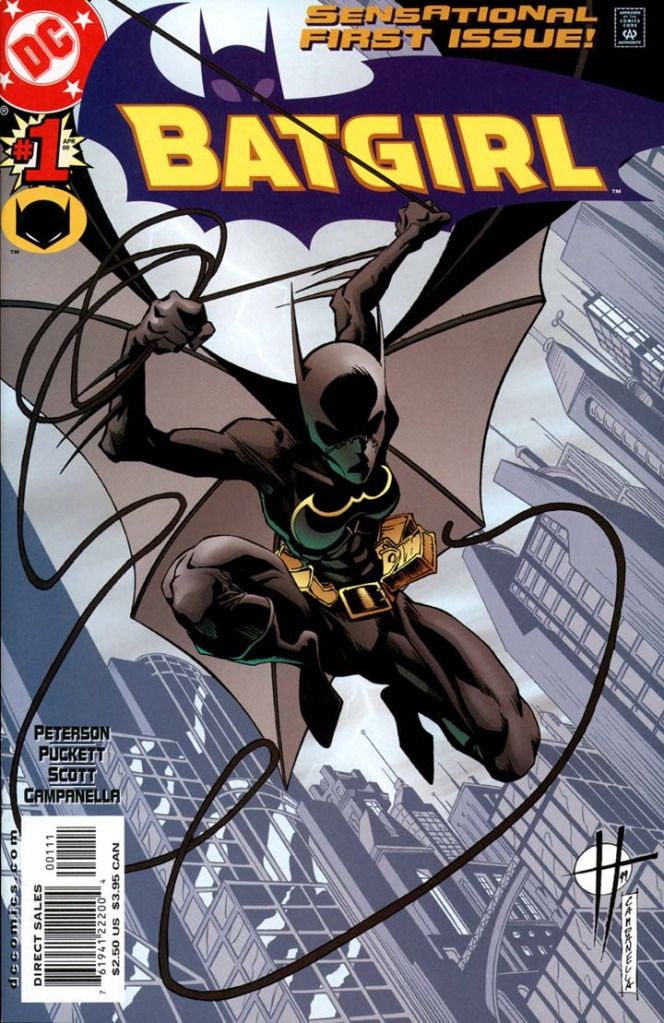
Batgirl #1 (April, 2000)

Script: Scott Peterson, Kelley Puckett
Pencils: Damion Scott
Inks: Robert Campanella

Synopsis:  Following a flash back to her childhood where she brutalizes some yokel claiming to be a mercenary, we catch up with Cass as she settles into her new digs under the loving care of Barbara "Oracle" Gordon.  Batman takes Cass out for a night on the town, which involves violence.  Cass begins to learn the power of bat symbol and the meaning of her new identity just in time to confront the very same mercenary whose life she ruined all those years ago.

You have to love the rule of threes.  Three billy goats gruff, Three Wise Men, three wishes, cube steak, the three-act screenplay structure.  Cassandra Cain's three encounters with the all-time loser of losers-- a guy so phony tough he makes Wyatt's brother Chet from Weird Science look like "Chopper" Read-- provide a framework for what would otherwise be a plot-free premiere issue.

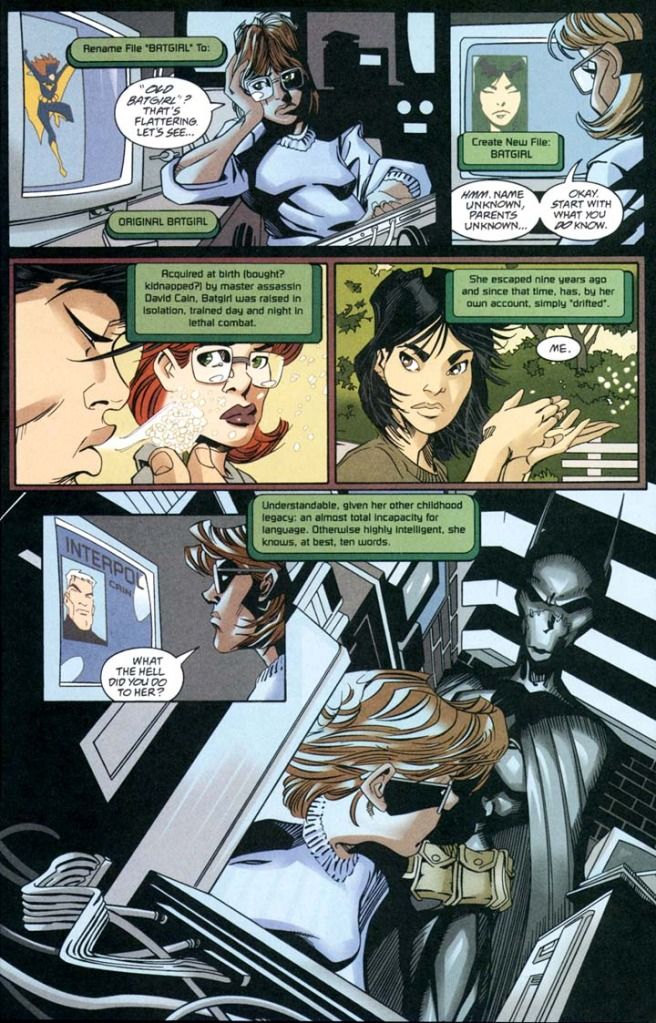
It starts with little Cass.  Her father, the assassin David Cain, has invited a group of mercenaries to spar with what they believe to be a harmless child.  Our hapless wannabe, a buzz-cut figure with the word "MERC" helpfully tattooed on his arm, refuses and ends up in the hospital for his troubles.  Flash foward to present-day Gotham City and Barbara Gordon (during her Oracle phase) acts as caretaker for that child, now grown up into the Cass Cain we all know and love: a silent, moody teenager but even deadlier now that she has some size and muscle on her.

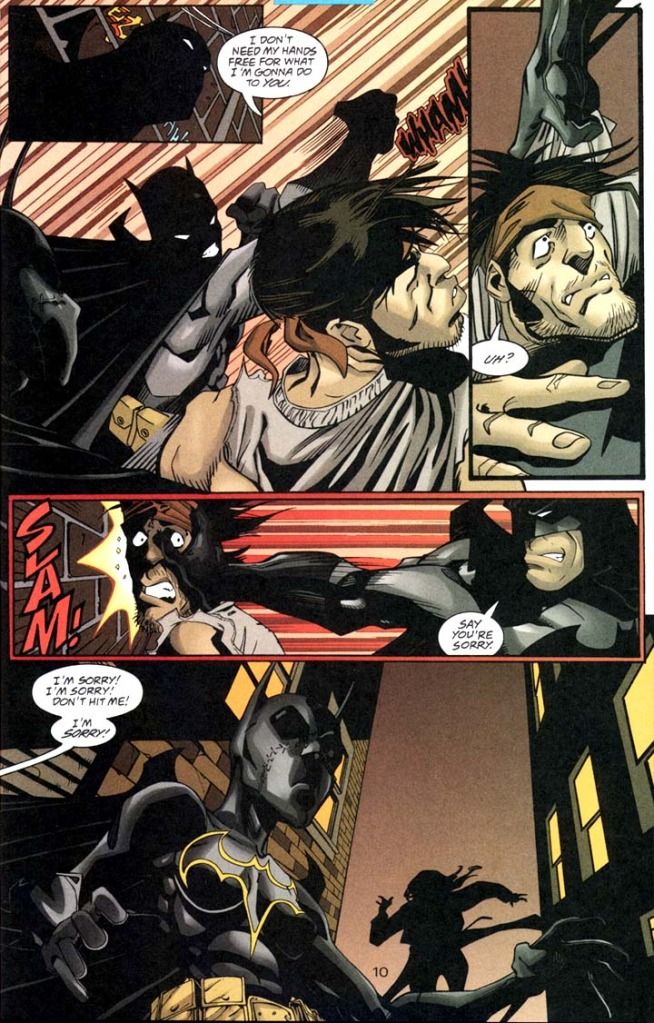
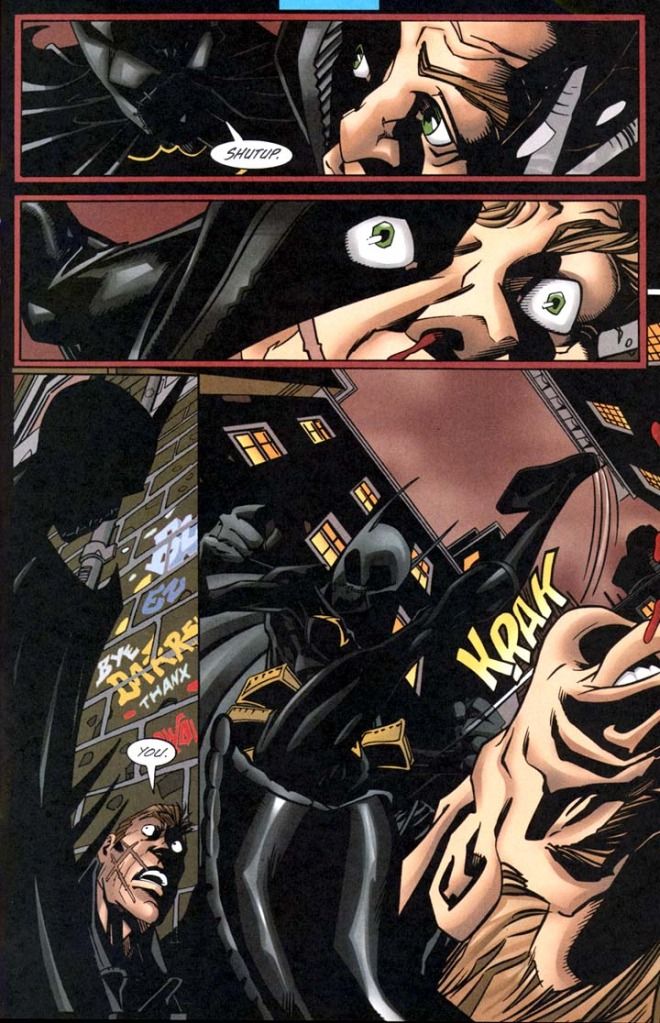
After writing team Scott Peterson and Kelley Puckett set up the particulars, they have Batman take Cass out for her first anti-crime patrol, which features a nasty scene where they stop a rape.  It's an overly familiar scenario, one lazily used in any number of hacky comics to establish a character's bona fides as a toughie.  As per the Standard Comic Book Storytelling Rulebook, our heroes just happen to be in the right place at the right time (there's little or no thought given to how the rapist and his would-be victim found themselves there because that's beside the point, apparently).  Lost in his teeth-gritting tough-man pose, Batman thoroughly terrifies both culprit and victim.

When the ostensibly heroic Batman blows his top and can't resist brutalizing the would-be rapist, Cass reacts with surprise.  Well, she's wearing that faceless mask, but the pose suggest surprise, or some kind of consternation.  But the source of this surprise is left ambiguous for now.  Perhaps Cass, with her abnormally strong empathy, is sensing something repulsive in Batman.  As grotesque as the rapist is, this is one of those cranked-to-eleven Batman moments and doesn't show him in a particularly good light. There's zero concern for further traumatizing the victim (who remains a cipher) and precious little for the effect of his actions on Cass, herself a victim of abuse and violence.  It may be that Cass sees herself in Batman's actions, and doesn't particularly like it.  After all, there are those two flashbacks, one in which the child Cass performs her own act of horrific violence and a later one where she witnesses its long term aftermath.

Her world seems defined at this point by violent men.  One has to wonder if she's traded one sadistic father figure for another.

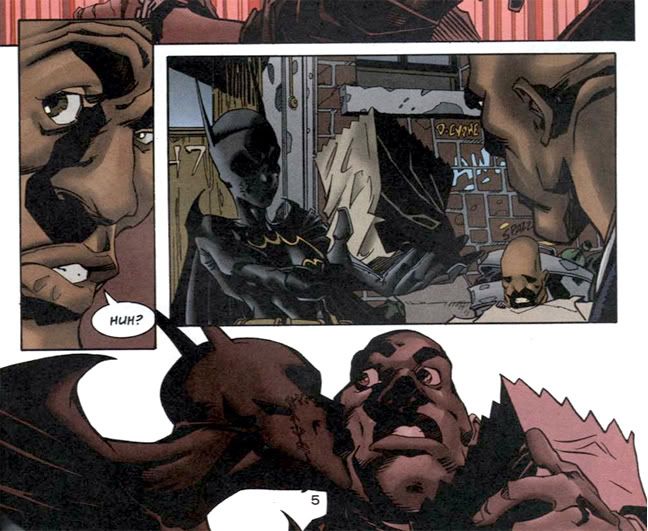
As story climaxes, Cass confronts that doofus of a merc again.  This time, he's killed a guard in a robber attempt of some kind and Batman sics Batgirl on him.  Why would anyone choose Gotham City of all places to pursue a criminal career?  Our nameless merc-- granted he isn't that bright-- has been all over the world and could have chosen a more lawless place, but here he is in one place on earth protected by a guy who has a mad-on for whipping criminal behind.  It's just his tough luck he also happened to choose the very night his long time nemesis Cass Cain is trying out her bat-wings.

It's a long-shot coincidence, but it allows Peterson and Puckett to bring their thematic concerns of fear and identity to their logical conclusion.  Cass, as Batgirl, becomes Batman's ritualistic stand-in.  While the story suggests she's already developing qualms about his methodology and guidance, as well as the beginning of her own ideas as to what she hopes to accomplish-- a recurring element in later issues-- by its end Cass has learned a lesson in myth-making and using it to help in her mission.  Finally, Batman presents her with the city (with a couple of caveats) and the series is off and (silent) running.

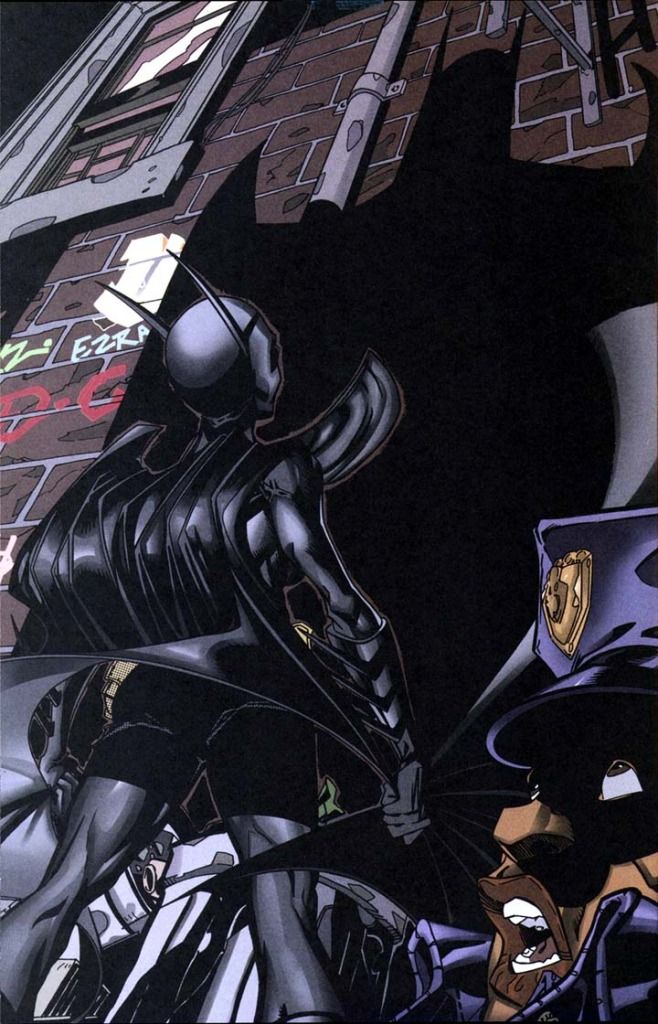
 Scott's art is quirky and fun, and he excels at facial expressions.  I like his funky figure construction and particularly his version of Cass.  Too many artists on other titles draw her as a 7 foot tall supermodel with slender limbs and gigantic breasts, as if their main goal isn't a relatively convincing character but to encourage the readers to masturbate along with the story.  Rather than go for the stereotypical sexy superwoman who seems poured into the costume from the pages of Maxim magazine or the Sports Illustrated swimsuit issue, Scott' gives Cass a shaggy, haphazard haircut, heavy eyebrows and a pinched, orphan's face; she also has the short, wiry physique of a bantamweight kickboxer.  Scott pays almost as close attention to body language as Cass herself does.  When you have a silent character in a faceless mask, it's important the artist choose the correct poses to sell each moment.  Cass's reaction to Batman's brutality is one, as is another later in the comic where Cass finds herself casting Batman's shadow on an alley wall.  Campanella's slick ink job makes it very appealing, very contemporary, with animation, hip hop album cover art and manga influences, lots of speed lines and the illusion of antic motion.

Compared to other superhero origins like radioactive spider bites and mutant abilities-- both of which boil down essentially to "magic"-- Cassandra Cain is an inspired concept: a child raised to replace language with kinetics, giving her the ability to read an opponent's every move.  As the result of intense training starting from birth, she possesses no verbal or written communications skills, but she does have unmatched fighting techniques and can apparently learn new ones in a matter of minutes the way you or I would learn vocabulary in a foreign language.  Or, in Cass's case, her native language, which is violence and movement.  Perhaps psychologists, behaviorists and martial artists could rip it apart as unlikely if not completely impossible, but it has the advantage of at least seeming plausible-- more so than a bullet-proof alien messiah with near-limitless strength or someone who can change the outcome of physical laws merely by talking backwards.


Obviously, the very idea of even such a child bringing grown men to their knees, much less breaking their jaws, is absolutely ridiculous, even more so than petty crooks coming halfway around the world to challenge Gotham.  Most criminals actually are that idiotic, but undeveloped muscles just don't work like that.  It's slightly more acceptable than one of those "Ninja Baby" shorts from America's Funniest Home Videos, mainly because it's played sincerely and... because superheroes are inherently stupid and we just have to accept that as our price of admission into Cass's world.  After that, it's up to the creative team to make it easy for us and here they're largely up to the task.

What Batgirl does most effectively is play on the visual dichotomy of someone in one of the most vulnerable of societal groups actually being a hyper-competent ass-kicking machine.  Cass's antecedents include Pippi Longstocking, Sally Kimball from the Encyclopedia Brown series, Emma Peel from The Avengers, Lady Snowblood, whose slender physique and fragile appearance bely her deadliness, Buffy Summers, the "chosen one" cheerleader with powers themselves derived from some kind of magical source lost in prehistory and Max Guevara, genetically-bred super-soldier who rebels against her nature from Dark Angel.  Killers-come-later in the Cass lineage include the egregiously over-the-top Hit-Girl from Kick-Ass and the more sober version Hanna from the film... er... Hanna.  That's just to name a few.

It's obviously an attractive dichotomy, perhaps one springing from some inner BDSM streak and desire to be dominated by some winsome lass-- although as I've pointed out, Cass isn't overtly sexualized.  I seem to remember a scene either edited out of the movie Pulp Fiction or written into the script but never filmed where Mia Wallace quizzes Vincent Vega if he's every fantasized about being beaten up by a girl and he lists a several, including Peel and Kimball.  Obviously, it's crossed Quentin Tarantino's mind, and I could easily imagine someone adding Cass to Vincent's list in some ill-advised remake (which is probably inevitable within our lifetimes).  It must be in the air.  Maybe it's a form of gender empowerment.  Female-identified readers can imagine themselves as Cass.  Maybe it's simply just a lot of fun reading a ripping action yarn in which a small girl and/or teen stomps burly criminals senseless.

Maybe Batgirl is all of those things at once.  We can read the text in any of those ways and make our case accordingly.  As a matter of fact, we have.

I can't fault DC for trying to exploit a good idea (shoot, this blog exists, right?), and the Batgirl creative team largely succeeds right out of the box.  Their Cass has a rangy, knotty musculature and a confused vulnerability that aid the suspension of disbelief even if the story's contrivances work against it.

Sunday, September 16, 2012

My Ten Favorite Cassandra Cain Moments...

Cassandra Cain is one crazy kid and she's so damned hard on people. I've lost count of how many times she's beaten up her biological father and her best friend, and the fights she's had with both her mentors plus their various proteges. Well, I suppose being raised as an engine of violence tends to do that to a young woman. Or anyone, for that matter. Here are my 10 favorite Cass Cain moments from the first 50 issues of Batgirl (there have been precious few since).  Oh, and I altered a couple of "controversial" jokes from my original posting of this.  No point in antagonizing people this early in the game:

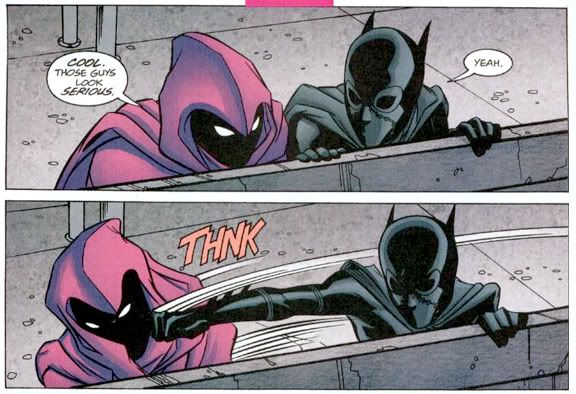
1) The Impulsive Kiss (Batgirl #2). This is the moment that hooked me. Batgirl puts a major ass-whuppin' on some stereotypical comic book tough guys to save this bald guy and his pet paper bag, then plants a kiss on his cheek. It startles him the same way it startled me; here's Little Miss Kung Fu, silent and damaged, showing tenderness. Something soft and human resides in her, despite the abuse she's suffered.

2) Take That, Spoiler (Batgirl #27). Early Cassandra Cain had little use for social niceties like-- you know-- greetings, farewells, the stuff in between. It made it difficult for her to make friends, and she barely seemed interested. Somehow, she ends up making friends with the largely incompetent Spoiler. Cass starts training her, but rarely takes her seriously as a partner, an attitude she makes quite clear when she simply cold-cocks poor Spoiler to keep her out of a fight rather than take the time to explain to her she's only going to get herself killed. It's easier this way, plus it illustrates on how much higher a plane Cass operates.

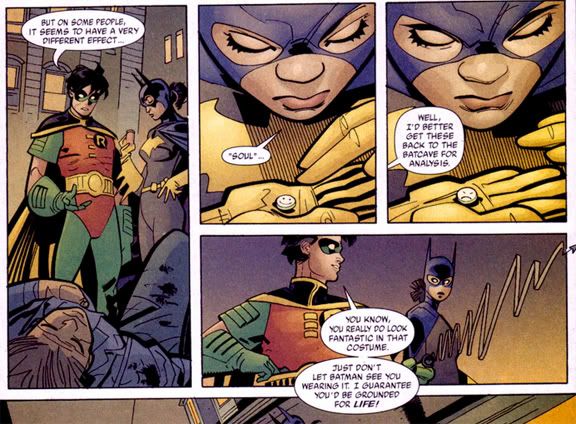
3) Up Yours, Barbara (Batgirl #45). Cass also takes on Barbara Gordon's legacy as the first Batgirl by putting on her clothes and fighting crime. She has to endure a lot of sexist "compliments" from Tim Drake.  Nice going, fella. High heeled boots prove Cass's undoing, but she redeems herself by once again beating the snot out of every sucker she meets.

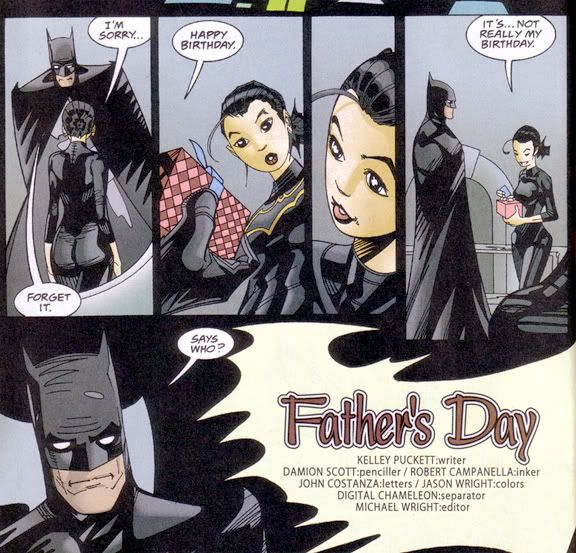
4) Celebrating Her Birthday on the Wrong Day With Batman (Batgirl #33). I forget how many times writers had Cass work through her father issues with both her biological father Cain and her father-figure Batman. This is one of the sweeter moments, coming just after Cass has visited Cain in prison and knocked him out for being a jerk. The kind of jerk who thinks shooting his daughter is a good way to train her to be tough. After learning her true birthdate, she immediately rejects it in favor of Batman's choice. Choose your father, choose your birthday, Cass.

5) Lying to Batman (Batgirl #36). But while she may have substituted Batman for Cain as her dad-of-record, both men have to deal with the force of nature that is Cassandra Cain. And it's about as easy as taming a taifun. She constantly disobeys DC's scariest asshole: from putting her Batgirl identity ahead of her relationship with her caped mentor to going against his wishes and letting a criminal go free, then blatantly lying to his face about it (and do you think Batman doesn't know? Who's being naive, Kay?), Cass shows everyone she's going to do things her way or no way.

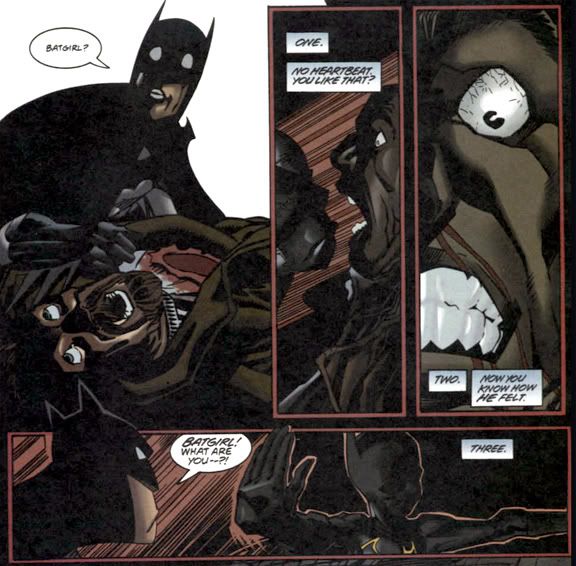
6) She's Also a Teacher (Batgirl #6). I always imagine Batman's relationship to Cass has been something of a hand's relationship to a handle-less knife-- one wrong move and you will get cut. Cass is dangerous and she has her own ideas about how to do things. Never is this more apparent than when she horrifies the uptight Batman with this literally heart-stopping lesson in empathy for a bad guy.

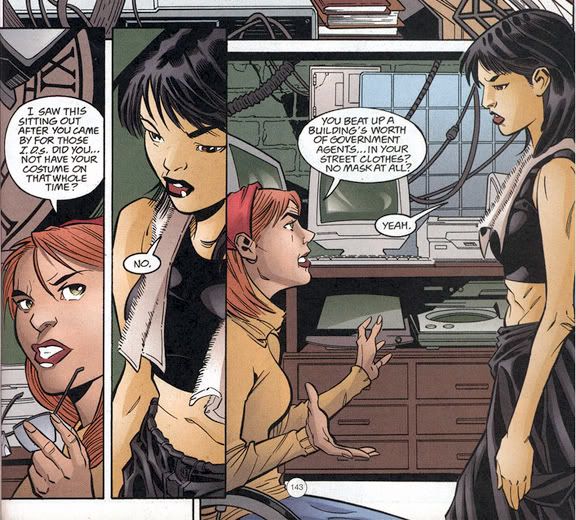
7) Normal Life? Who Needs It? (Batgirl #14). Especially when you can be Batgirl full-time. Here Cass freaks out the traditionalist Barbara Gordon by beating up a team of government agents without bothering to wear a mask. Cass couldn't care less about living a "normal" life. And when your family consists of imprisoned murderers or overly rigid assholes who hide behind masks, who are you trying to protect by doing the whole "secret identity/double life" gag? No one, according to our little iconoclast.

8) Not a Quitter (Batgirl #7). Batgirl's greatest skill is her ability to read her opponent's body language, which enables her to predict any move or counter. But it comes at the cost of language. When a psychic rewrites her brain, Cass gains words and their meanings but loses her fighting edge. While she's still deadly on offense, she completely lacks defense-- but she will stop at nothing to learn, as Batman finds out here. Wow, how many times did she manage to freak out the ever-intense Dark Knight Detective with her own ultra-high levels of intensity? Like Arnold as the Terminator, this girl never gives up, DC. Never.

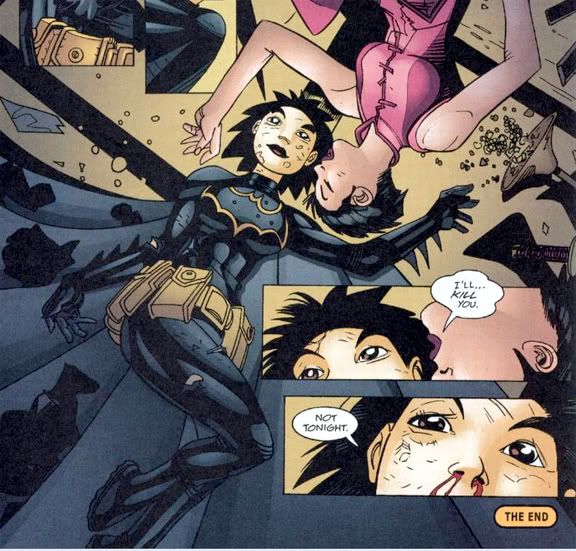
9) Beating the World's Deadliest Martial Artist (Batgirl #25). To regain her body language reading abilities, Cass makes a heavy bargain with Lady Shiva, the deadliest fighter alive (next to Cass). Lady Shiva grants Batgirl one year of perfection, but they must fight to the death. This plays into Cass's guilt at having killed a man when she was a child. It also feeds her death wish. On the chosen day, Cass accepts her fate, then manages to do the nearly impossible, further cementing her spot as one of the DC universe's most dangerous martial artists.

10) This is Your Batgirl. This is Your Batgirl on Drugs (Batgirl #50). Being a child of abuse and generally unable to express her more torturous emotions, Batgirl frequently acts out. The whole death wish/Lady Shiva/lying/disobeying Batman thing gets her fired as Batgirl but she keeps on keepin' on. One more time, DC: she will not quit. Because he knows she's so damaged, Batman shrewdly decides the best way for the two of them to settle their father-daughter differences is with a fun shopping trip to the Gotham Mall and a long talk over a shared sundae... Actually, they get drugged up on some crazy anger concoction and throw down. The result is an epic fight during which they bond while beating up Nightwing. Batgirl doesn't always know the difference between a hug and a roundhouse kick to the face. And with her, they both sometimes have the same meaning: "I love you, Daddy."