One of the fun aspects of going digital with Comixology (and possibly Dark Horse as well, although I have yet to experiment) is having the ability to download your comics to your iPhone and read them through Comixology's app. Yes, this traditionalist finds reading comics on an iPhone fun. I downloaded all my Cass Cain Batgirl issues to my phone (plus my Nexus, New Mutants and old school Valiant titles) over the weekend and they really came in handy yesterday as I ran errands and spent a lot of down time just waiting for others to handle their end of my very important business.
My initial objection to doing this involved not being able to scan the entire page.
I believe page layout to be a dying art in this age of "widescreen" storytelling, where artists generally just stack a lot of horizontal panels on top of each other, then break it up with a vertical close-up inset shot of someone screaming. There aren't that many Will Eisners or Bernie Krigsteins or even Jim Sterankos walking around. It's gotten to where I prefer someone just doing the ancient "three tier" format because you don't have to figure out panel order and sometimes the panels come closer to that pleasant "golden ratio" centuries of Western art has taught us to recognize and love. For example, Jamie Hernandez with his beautiful drawings and simple, clean, fun page layouts.
Page layout is just as important as the panel-to-panel stuff in leading your eyes around and through the action. A good storyteller remembers all that plane of action stuff and where the characters are relative to each other within each panel, but also helps the reader understand what's happening by doing the visual equivalent of expert tour guiding. Plus all those tricks Will Eisner talks about in his books, varying panel sizes and shapes to create the illusion of time passing at various speeds. It all goes back to layout. As a reader, you approach the page as a whole, then delve into the little squares and rectangles within which your favorite characters strut their stuff. I didn't want to lose that.
Anyway, to my surprise, I discovered Damion Scott's Batgirl actually reads better on the iPhone, which takes you through with the rest of the page cropped out, than it does when you have the actual comic in front of you. While he's an excellent action-based storyteller in panel-to-panel terms, sometimes his pages are a bit busy. On the iPhone, some of Scott's panel-to-panel transitions almost animate themselves as you click through. It's a neat effect.
Some of the other books I looked at didn't fare as well. Panels had to be awkwardly snipped to fit on the screen and then "slide" so you could get the entire scene. Sometimes it would give a nice cinematic pan instead, which was often a revelation. Usually, though, this would have a "pan-and-scan" effect like watching a movie cropped to fit one of those TVs like the ones I grew up with, the heavy, wood-framed beauties that were as much furniture as they were entertainment centers. It creates reading pauses that run counter to the artists' intentions.
The small size of the iPhone reduces the figures, which simplifies them slightly so you're losing a bit of the rendering the artists worked so hard on. That's a bit of a disappointment. Again, it serves Scott well because he specializes in broad acting, big, bold expressions and stylized faces that show up quite clearly on the iPhone screen. Some of the artists who use a lot of subtle, fine-lined work tend to soften. I wouldn't suggest any artist change his or her drawing style to fit this medium, but I think artists with simpler looks with fewer lines and lots of black spotting like Mike Mignola and Bruce Timm won't lose a whole lot on iPhone.
On the other hand, the text remains surprisingly clear and readable. So there are trade-offs to the convenience of being able to carry with you at all times as many comics as your iPhone's storage capacity allows. I see it this device more as an adjunct to your reading experience than a replacement for larger formats. It's a matter of convenience reading.
Now my main qualm about Comixology and Dark Horse digital comics is you're paying the same amount as you would for the print issue, but you don't actually own the comic itself, just a license to read it on your computer or phone. At home, I can't download the comics I've paid for and read them offline. I have to visit the websites. I can understand this from a standpoint of preventing piracy, but to be frank, that Black Pearl has already sailed. For now, this kind of like buying comics but keeping them at your friend's house and reading them through a window while she holds them up and turns the pages when you ask.
Even so, here in Japan where American funny books are difficult to come by, digital comics are your best bet for immediate gratification. Walking Dead has been making me kind of sick lately, but at the same time, I can't look away. When #107 comes out, I'm going to be there on the first day rather than having to wait for a collected edition or make a trip to Tokyo in hopes it hasn't sold out at Blister. And it's nice to know I have access to every issue of the Cass Cain Batgirl no matter where I am or what time it is.

Showing posts with label Will Eisner. Show all posts
Showing posts with label Will Eisner. Show all posts
Wednesday, January 16, 2013

Monday, January 7, 2013
Batgirl #2 (May 2000)
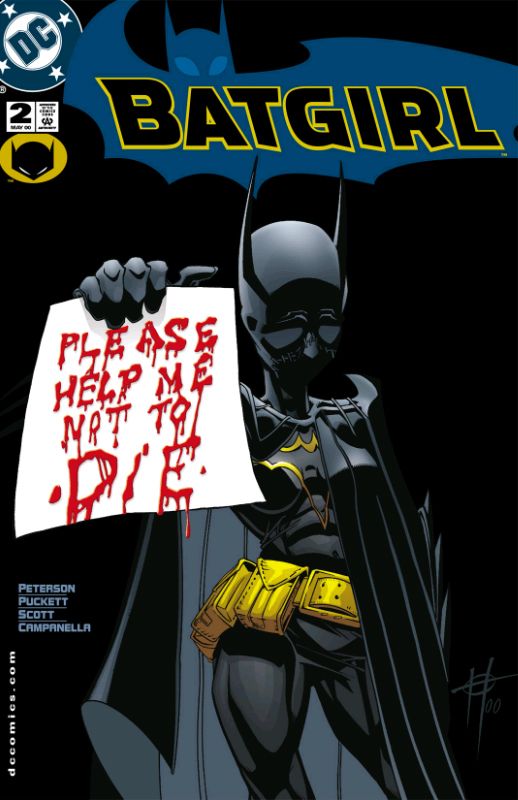
Script: Scott Peterson, Kelley Puckett
Pencils: Damion Scott
Inks: Robert Campanella
Colors: Jason Wright
Colors: Jason Wright
Synopsis: After playing the good samaritan and intervening in some kind of mob-related romantic altercation, Gotham citizen John Robinson needs a helping hand himself. Of course it's Batgirl who leaps into action. When she finds out Robinson's been kidnapped by the mobsters, her protective nature kicks into overdrive. Oracle helps her locate the guy, but if only Cass had better verbal and written communication skills-- or any at all-- she might have avoided a harsh lesson in love and loss.
This is a taut stand-alone tale of the kind I wish comic book publishers did more of these days. With nary a wasted moment-- and despite an emphasis on action and fights-- Scott Peterson and Kelley Puckett introduce a minor character, develop him just enough so you have real concern for his plight, rather than just have him exist as a inciting element. Certainly, he's that, but a little more than that, too.
The writers also use a point of view change near the end to enable readers to see Cass from the outside, but as the melancholy ending shows, they don't neglect her inner being either. Actually, this is the first issue where we see signs of some of her signal personality traits-- there's the impulsivity which gets her involved with the good samaritan in the first place (and leads her to plant a quick kiss on his cheek as a reward for his being such a nice guy) and the irresistible way she draws support from Oracle without using words. This issue introduces Cass's implacable, on-task nature. Once she sets off to rescue the kidnapped man it's all Oracle can do to keep up with this whirlwind in black. Oh yeah, and there are a number of violent action sequences, starting with the initial fight that sets up the plot and ending with Cass taking on a whole bunch of suited Mafia types all by her lonesome. It's not on the level of the Bride versus the Crazy 88s, but I have a feeling if it had been Cass in the House of Blue Leaves, there would have been no fatalities but the fight would have lasted only half as long.
Cass begins to show signs of understanding at least a minimum of English. Her ability to read body language means she's not completely incommunicado, but while she seems unconcerned and even mocking about learning at the outset-- much to Oracle's understandable frustration-- she comes to realize by story's end not only is she cutting herself off from human interactions, she's hurting herself as far as the Batgirl identity goes. Knowing more than a word or two may come in handy when fighting crime.
This story reminds me of one of Will Eisner's The Spirit, which sometimes featured a simple plot rounded out with humanism or a particular mood somewhat deeper than your usual pulp actioner. "The Story of Gerhard Shnobble," about a schmoe who could fly, for example. It's a bit of downbeat fantasy, more a vignette than full-fledged narrative, with the Spirit relegated almost to the background. Eisner shows the Spirit's adventures sometimes have unintended consequences and they're not the only thing happening in this particular world. John Robinson is Cass's Shnobble, the major difference being she actually interacts with him and has an emotional epiphany as a result, which is the purview of the readers and denied the Spirit in Eisner's tale. But in the same way Shnobble deepens the Spirit's world, Robinson reminds us Gotham City as a story setting is packed with people living fully dimensional lives and the impact they might have on Batgirl and vice versa. It's Eisnerian to see Cass through Robinson's eyes and provides the feeling of what it must be like to live in a city lousy with black-costumed heroes and their vicious enemies. Simply by trying to do the right thing, this ordinary man is caught between the two extremes and pays a heavy price, but it's the emotional impact on Cass and on Robinson's wife we're concerned with rather than just the mechanics of a typical Cass ass-kicking.
The final panel is particularly reminiscent of Eisnerian storytelling as well. Because Eisner was a genius, it's not as heartbreaking as anything in "Gerhard Shnobble" (which ends with a note it's humanity we should pity, not Shnobble), but it's affecting. There's a potential here for some truly ground-breaking storytelling, with Batgirl experiencing the superheroic world as an outsider, almost an alien observer of these human mysteries, her interactions sometimes confusing and as painful for her as it is for the people she beats up so thoroughly. With its whip-snap narrative speed, the series doesn't do a whole lot with this theme from here on out, but it's evidence of the basic richness of Cass the character there are so many different directions a smart writer could take her, from traditional adventure to stories with more emotional resonance, or-- my preferred route-- doing both a la Koike Kazuo's Lady Snowblood and Lone Wolf and Cub.
I have to admit the first time reading these I found Damion Scott's layouts and panel-to-panel flow difficult to follow. Now I think I have a handle on them. There are a lot of nice moment-to-moment-- or what Scott McCloud would call action-to-action-- progressions here. Robinson picks up a board (which, frankly, Scott renders haphazardly), wades into the fight. Towards the end, Batgirl becomes a veritable whirling dervish of destructive energy. Scott doesn't neglect the acting-- the facial expressions and body language here are broad and cartoonish but far superior to some of the crap I've seen names with larger fanbases pull off. And it beats the stiff "I use Poser models to plan my pages" or overly photo-referenced stuff some of the realists do. Sequential storytelling is a complex art unto itself and Scott nails it here.
Subscribe to:
Posts (Atom)