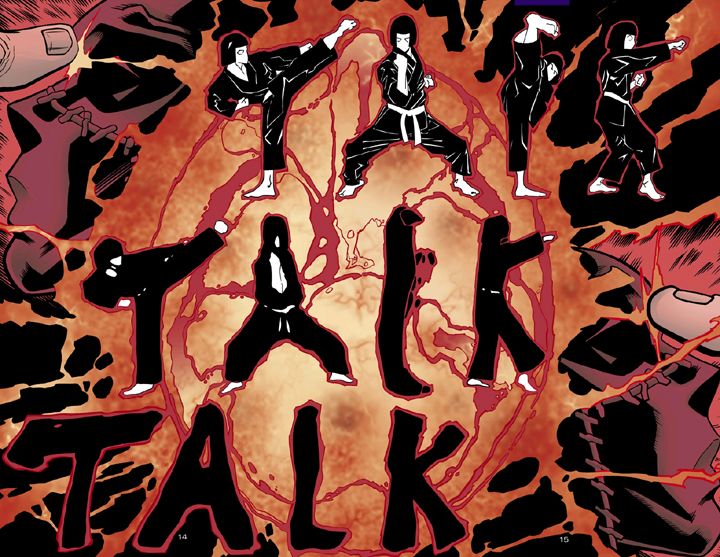
When we first met her, Cassandra Cain could not express herself through spoken language. She had no vocabulary in the traditional sense of knowing words and their meanings. She did have an extensive non-verbal vocabulary, however. She could understand gestures and even developed a form of empathy because of her intense understanding of body language (her famous ability to "read" a person's intentions, making her almost invulnerable on defense in a fight) and facial expressions. This proved the undoing of her father David Cain's plan to raise her as the ultimate assassin.
Far from being incommunicado, Cass could be extremely communicative. One early example of Cass expressing a fairly complicated idea non-verbally is in
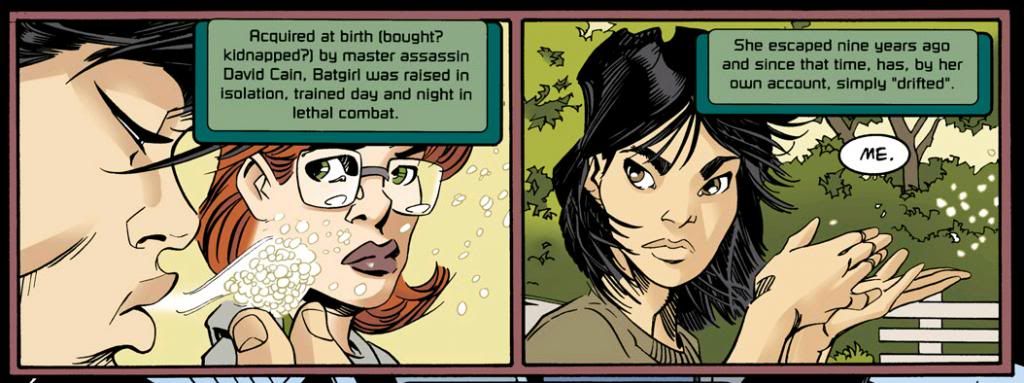
Batgirl #1 (April 2000). Using a single word ("Me.") and blowing a handful of dandelion fluff into the wind, Cass is able to tell Barbara Gordon how she "simply 'drifted'" before turning up in Gotham City.
 |
| Scott Peterson, Kelley Pucket, writers; Damion Scott, Robert Campanella, artists (Batgirl #1, April 2000) |
This indicates understanding symbolic meaning at a very high degree. She can associate the action of the plant seeds, relate this to her former situation, link the two with one of the few English words (we have no idea if she picked up any others from the languages she no doubt heard during her "drifting" years) she knows, and use this with a mind towards Barbara's understanding.
Cass, however, spent the better part of her young life virtually culture-free as she wandered the earth alone. She existed within the margins of society, learning by observation but with the context language and language-based social interaction provide. At some point, she must have made the connection between the noises coming from people's mouths and the understanding of those noises by the listeners. She must have become aware of language. She must also have become aware of various gestures as she travelled the world.
In
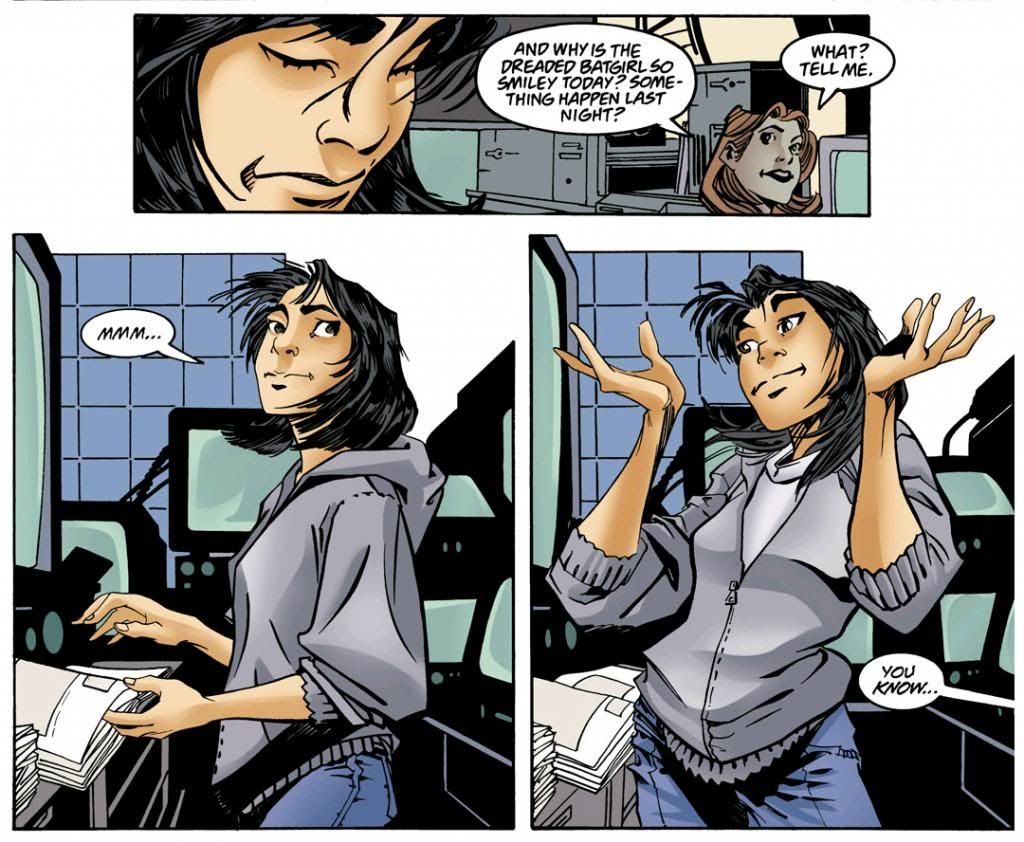
Batgirl #2 (May 2000), Batgirl has a particularly good night as a crime-fighter, then uses a shrug to dodge Barbara's line of questioning about why she seems so chipper.
 |
| Scott Peterson, Kelley Pucket, writers; Damion Scott, Robert Campanella, artists (Batgirl #2, May 2000) |
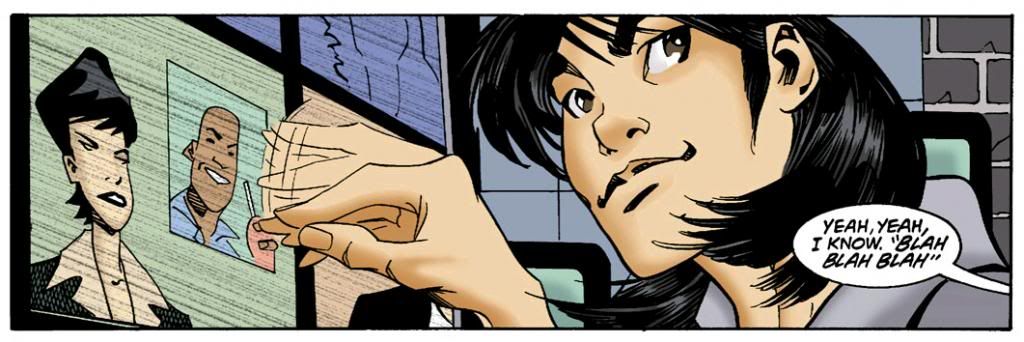
Barbara has no trouble understanding Cass's meaning. She's not "talking" about why she feels so cheerful. A page later, Cass uses a flapping hand to indicate her belief that talking isn't all that important and that some people do it way too much.
 |
Ibid.
|
Cass knows the concept of "blah blah blah," without knowing the verbal expression for it. Where did she learn this gesture? At this point in the story, Cass has spent the better part of her young life living virtually culture-free on the margins of society, and not exclusively in Western nations where there's more of an overlap of media. This may be something she's developed on her own, much like the demonstration with the dandelion. To those of us who are verbal and well-versed in pop culture-- a la puppets and Muppets-- such a gesture comes quite naturally. The flapping hand is a rough visual approximation of flapping lips, and the single hand nature of this gesture renders it even more dismissive. Cass might have also made the visual connection, especially given her native intellience level which appears to be pretty high.
She may also have seen someone use it in her travels, or on television following her settling in with Barbara Gordon. At any rate, I can't vouch for this gesture's universality. I was raised in the United States where most people understand it, but I live now in Japan and haven't really encountered anyone flapping their hand like this. Or, if I have, I've forgotten about it because it wasn't particularly memorable. You know, I should probably do a survey at some point to see if this gesture has the same meaning here in Japan.
In the US, for example, if I want you to come, I draw you closer by curling my hand back toward myself over the top of my elbow. In Japan, I'd simply hold my hand out front, palm-down, and kind of wave it. If I want to pass between someone, I make a hand-chopping motion and kind of lower my head a little. If I say something that's incorrect, I wave it away with a hand in front of my face. In the US, if I refer to myself, I gesture towards my chest. Here in Japan, I do the same thing by pointing to my nose.
For Cass to be multi-lingual in this way, without speaking, she'd have to master the gestures of several different groups. It would be possible under these circumstances for Cass and Barbara Gordon to have a gestural conversation in several different non-verbal languages.
On the other hand, ass-whuppin's are a universal language. We all understand the meaning of the beat-down. Cass has also been known to send a message by stopping a person's heart for a moment before restarting it. Communication through combat. Cass is one of the most fluent in this language found in comic books. Unlike most of the others, however, this is her native language. The others are all AWFL or AWSL learners.